Beauty and ugliness
The Lying Life of AdultsBeauty and ugliness in The Lying Life of Adults are not fixed qualities so much as judgments made through other people’s eyes. Giovanna grows up amid competing standards of refinement and vulgarity, learns to treat her face as a family inheritance, and gradually sees that an attractive appearance guarantees neither happiness nor goodness. The idea culminates in a difficult recognition: being called beautiful can flatter her while also helping her justify an act that would make her resemble the people she condemns.
Faces and inherited judgment
From childhood, Giovanna’s appearance is entangled with anxiety about family resemblance. Her parents’ efforts to dress and prepare themselves before visits to Vittoria carry an apprehension they do not explain to her; their warning is that she should pretend not to hear if Vittoria says something. The family’s carefulness makes appearance seem part of a wider effort to manage what can be seen and spoken. As Giovanna later recalls, she recognizes that unease as a persistent disturbance within what had otherwise been a happy childhood.
Vittoria makes the family’s visual judgments explicit. She tells Giovanna that she is growing badly, mocks her pink clothes, and challenges her to say whether she believes lies more readily than truth. Her criticism does not stop at clothing: she presses Giovanna to examine the people and conditions around her rather than accept her parents’ account. In Vittoria’s repeated demand to look closely, seeing becomes a discipline directed against inherited assumptions, though it is also a way of imposing her own judgments.
The resemblance that troubles Giovanna is not simply a matter of individual features. Her father has let slip that she is beginning to acquire Vittoria’s face, and Giovanna later connects that remark to the possibility of inheriting the aunt’s capacity to hurt others. The face functions as a feared moral likeness: to resemble Vittoria may seem to mean becoming like her, even when Giovanna is still trying to decide what her aunt’s example actually means.
Refinement, vulgarity, and belonging
The family’s vocabulary of beauty is bound up with class and education. During visits arranged by Vittoria, Giovanna meets her father’s siblings and other relatives in their homes across Naples, including Cavone, the Campi Flegrei, and Pozzuoli. The apartments strike her as drab and their furnishings as crude or vulgar by the standards she has absorbed. But the relatives welcome her warmly, speak in dialect mixed with Italian, and call her Giannina—a name her parents have never used.
That welcome unsettles the hierarchy through which Giovanna has learned to interpret people. Around these relatives she feels unusually open, relaxed, and funny; the affectionate name seems to bring forth a version of herself different from the Giovanna known to her parents, Angela, Ida, and her classmates. The contrast does not simply replace one ranking with another. Rather, it shows how the same person can appear different within different relations, and how the supposedly crude family members offer a kind of affection that Giovanna has not experienced in the same way elsewhere.
A similar social sorting shapes Giovanna’s understanding of Vittoria and Costanza. The women seem opposed in every outward category: Vittoria is uneducated, poor, and called vulgar, while Costanza is cultivated, wealthy, and regarded as refined. The bracelet associated with Vittoria, intended as a gift for Giovanna, later appears on Costanza, who has kept and worn it for thirteen years. For Giovanna, the object makes the opposites press together. Its journey between the women confuses the neat distinctions of taste, class, and beauty rather than confirming them.
The face and the promise of happiness
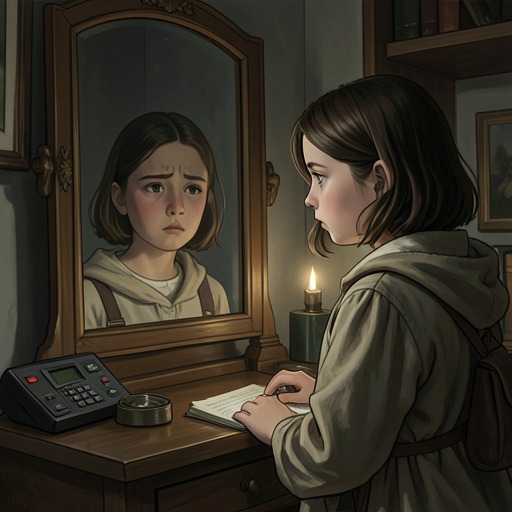
Giovanna’s reassessment becomes clearest after a period of family crisis. Looking at herself in the mirror, she finds her hair flat and her face lacking harmony, as she thinks Vittoria’s does. Yet she recognizes that making this a tragedy was a mistake. People with beautiful, refined faces, she observes, can conceal infernos no different from those expressed by coarse or ugly faces; beauty may even conceal or promise suffering more powerfully than a dull appearance.
The contrast is sharpened by Angela’s unhappiness after Tonino disappears from her life. Angela accuses Giovanna of failing to stand by her, and Giovanna imagines that Angela’s usually sweet, harmonious face has become uglier than her own. The imagined change reveals that appearance is being measured against emotional experience: distress can alter the meaning Giovanna gives a face without proving that the face itself has changed. Her perception now turns the old hierarchy around, making beauty no guarantee of a person’s inner state.
Later, a compliment from Roberto gives beauty a new and more dangerous force. When Giovanna visits him and Giuliana, Giuliana welcomes her and thanks her for the morning; Roberto looks at Giovanna and tells her she is beautiful. His judgment matters to her because she has been accustomed to seeing herself through her father’s comparison with Vittoria. But the compliment does not resolve that fear. Instead, it helps awaken pride and desire while Giovanna is traveling to meet Roberto, whom Giuliana loves.
Beauty, desire, and moral resemblance
On the train, Giovanna recognizes that she is not going to Milan simply to retrieve the bracelet or help Giuliana. She intends to betray Giuliana’s trust and take the place beside Roberto that he has offered her. She feels authorized by the fact that Roberto, whom she considers extraordinary, has called her beautiful. The compliment becomes more than reassurance: it offers a justification for pursuing what she wants.
That justification immediately turns against her. Giovanna connects the betrayal she is contemplating with Vittoria’s destruction of Margherita’s life and with her father’s destruction of her mother’s. In that comparison, resemblance to Vittoria is no longer just a prediction about her face. It becomes a possible resemblance in conduct. Giovanna feels guilty and recognizes that her wish to enter adulthood through Roberto is bound up with the possibility of hurting Giuliana; when she gets off the train, she is afraid that this is not the way she wants to grow up.
The motif therefore ends not with a final verdict on Giovanna’s looks but with a distinction between appearance and action. Roberto’s praise can make her feel newly beautiful, yet it cannot make her intended betrayal innocent. The story’s repeated reversals of refined and vulgar, attractive and ugly, expose the limits of judging people by surfaces; Giovanna’s most consequential test is whether she can see what her own desire is leading her to do.